"Just one more change" is the sentence that quietly wrecks outsourced-editing math. When you cut your own footage, an extra tweak costs you twenty minutes at your own desk. When an outsourced editor is holding the timeline, that same tweak means a written note, a wait for their queue, a new export, a new review link — and you sitting in the middle relaying feedback between a couple who don't think in rounds and an editor who bills in them. The videographers who outsource well aren't the ones with the best editors. They're the ones who agreed on a revision structure with the couple before the footage ever left the building.
Why Unstructured Revisions Cost More the Moment an Editor Is Involved
When you edit in-house, a revision is a cost you absorb silently — you open the project, make the change, move on. When you outsource, the same request becomes a round trip through three parties: the couple sends feedback to you, you translate and forward it to the editor, the editor turns a new version, and you send it back for approval. Each leg adds delay even when everyone responds fast, and every added day pushes the couple's expectation of "almost done" further out.
Video-review vendors who study this pattern report the same failure mode over and over: once feedback starts arriving after a first round of comments — a parent chiming in late, a partner disagreeing with an earlier note, a maid of honor with opinions about the music — the round count can multiply well beyond what anyone planned for. In an outsourced relationship, that inflation doesn't stay abstract. If your editor's quote assumed two rounds and a scattered group chat generates a fifth, you're either eating the extra cost yourself or asking a couple mid-planning-spiral to pay more for a wedding film they thought was finished.
There's a second, quieter cost: trust with your editing partner. An editor who agreed to two rounds and keeps getting a sixth learns to pad every future quote from you, whether or not this particular couple is typical. Protecting the round count protects the rate you get on the next ten projects, not just this one.
Compare that to what happens inside a studio that edits everything in-house. There, an extra round is invisible to a client — it's just the editor's time, absorbed into the studio's own schedule. Outsourcing removes that invisibility. Every round now has a name attached to a cost on your end, which is uncomfortable the first time you see it written out, but it's also the reason outsourcing forces studios to get disciplined about revisions in a way in-house editing never required. That discipline tends to help even the studios that later bring editing back in-house.
The fix isn't stricter policing of couples. It's deciding, before the handoff, exactly how many rounds are included, what a "round" contains, and who owns the conversation when a request falls outside that scope. Everything below is that decision, broken into the pieces you actually need to write down.
What "Included" Should Actually Mean in Your Contract
Across current wedding videography contract templates, one or two revision rounds is the standard inclusion — not unlimited "reasonable" changes, and not a single take-it-or-leave-it cut. The number itself matters less than whether it's written down. A well-defined deliverable list — exact runtime, format, and what's included in "the edit" — is one of the strongest defenses against revision creep, because clients who know precisely what they're getting have less room to argue the first cut missed the mark.
Define a revision as a change to something already shot and already in the edit: a shorter speech section, a swapped song, tighter pacing on the reception montage. A new request — adding footage that wasn't selected, restructuring the film's chronology, cutting an entirely new version for a different platform — is a new deliverable, not round two of the old one. Put that distinction in writing next to the round count, not just in your head.
This distinction earns its keep the first time a couple asks for something like a 90-second social cut built from the same footage as their 6-minute highlight film. That's a genuinely reasonable ask — but it's a new deliverable with its own timeline and, if you're outsourcing, its own line item with your editor, not a "quick addition" to round one of the highlight film.
The Three-Round Structure That Actually Works
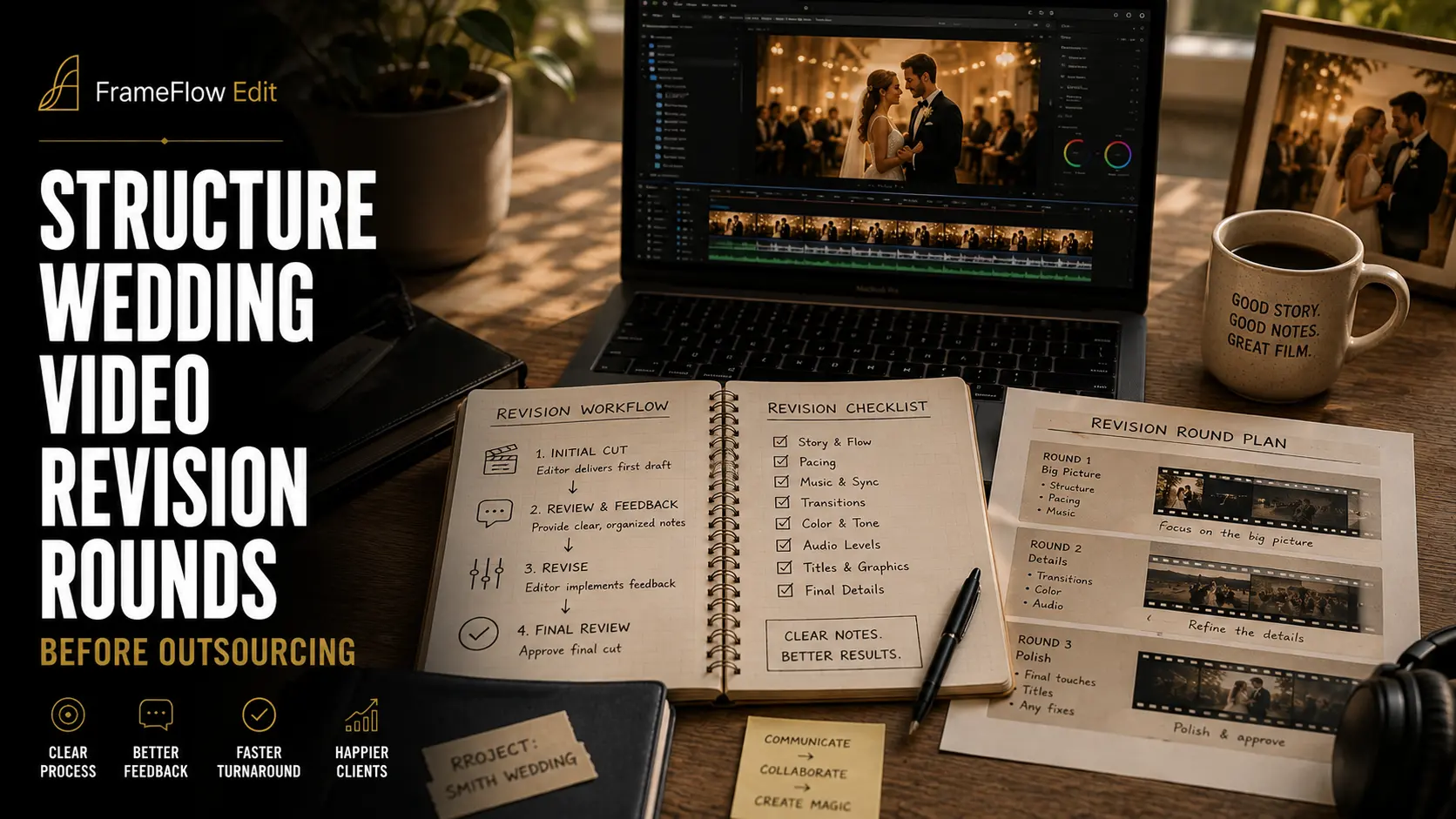
When studios do allow more than one round, the rounds that stay efficient aren't identical passes at "anything you don't like" — they're scoped differently from each other. A structure that holds up in practice looks like this: round one is structural feedback only — story order, pacing, which moments made the cut. Round two is polish — color, music choices, graphics, transitions. Round three, if it exists at all, is final nitpicks and sign-off, not a reopening of earlier decisions.
The reason this matters for an outsourced workflow specifically: your editor built the timeline around the structural choices in round one. If a couple reopens story order in round three, the editor isn't tweaking — they're rebuilding, and that's a different (and more expensive) piece of work than what either of you quoted. Locking round one to structure only, and saying so explicitly in the review note you send the couple, keeps every later round cheap.
It also changes what you ask for from the couple at each stage. When you send round one, prompt specifically: "does the story flow feel right — anything you'd cut, reorder, or extend?" When you send round two, prompt for tone: "does the color and music feel like you?" A couple asked a narrow question tends to give a narrow, useful answer; a couple asked "any thoughts?" tends to give you everything at once, out of order, which is exactly the unstructured feedback that costs the extra rounds this structure exists to prevent.
Setting a Feedback Window So You're Not the One Left Waiting
Editors — yours and your outsourced partner's — lose more time to slow client feedback than to the actual edit. Editors who track this report that the first draft is usually the smaller half of a project's total timeline, and the review-and-revise stretch that follows can easily stretch as long again, with most of that delay sitting on the couple's side of the inbox rather than the editor's. If you've built your turnaround promise into a sales argument, as covered in our guide to turnaround time as a sales edge, an open-ended feedback window quietly undermines the exact number you're using to win bookings.
Put a number on it: five business days is a common, workable window for a couple to review and respond with one consolidated note. State plainly that feedback arriving after the window, or arriving in scattered follow-up messages instead of one note, starts a new round rather than extending the current one. This isn't about punishing slow responders — most delayed feedback is simply life getting in the way of two people trying to agree on a wedding film — but a stated window is what lets you hold your editor to a turnaround estimate with a straight face.
Ask for feedback the way editors can actually use it: one note, timecoded, covering every reviewer's opinion in a single pass. "Cut the toast shorter" is a request. "Cut the toast at 2:14–2:40, it drags" is an instruction an editor can act on without a follow-up question, which is itself a saved half-round. Build a one-line reminder into the delivery email itself — "please reply with one note, timecodes where possible, within 5 business days" — so the rule travels with every round automatically instead of depending on you remembering to repeat it.
A short reminder at the 3-day mark, before the window closes, catches most of the couples who'd otherwise miss the deadline by a day and trigger a dispute over whether a new round has technically started. That single check-in email is cheaper than the argument it prevents.
Pricing Extra Rounds Without Souring the Relationship
Extra rounds should cost something, and that number should exist before anyone asks for one. Contract templates published for wedding videographers tend to cite an additional revision round somewhere in the $150–$400 range for a straightforward pass — a useful starting anchor, not a market-wide price — scaled to the complexity of the film and the studio's positioning, with fees running considerably higher, sometimes several hundred dollars more, when the request amounts to a real re-edit rather than a light touch-up. Whatever figure you land on, it needs to cover your real cost: what your outsourced editor charges you for an extra pass, plus your own coordination time, plus a margin that makes "sure, we can do a third round" a decision you're happy to say yes to rather than one that quietly loses you money.
Say the number out loud before the moment it's needed. A short line in your review email — "this is round 1 of 2, included in your package; a third round is available at [fee] if you'd like more changes after this" — does more to prevent an awkward conversation later than any clause buried in a signed contract nobody reread. Couples rarely push back on a fee they were told about in advance. They push back on one that appears for the first time attached to an invoice.
Treat the extra-round fee as a pricing decision, not just a deterrent. If you're already mapping outsourced-editing costs against your package price, an extra round should sit in the same spreadsheet as the rest of your cost-of-goods math, not be set arbitrarily. A fee that doesn't cover what your editor actually charges you for the pass is a fee that loses money every time a couple accepts it — which, if it's priced fairly, they usually will.
Choosing a Review Tool: What Couples Can Actually Use
The tool you route feedback through shapes how good that feedback is. A shared drive link and an email chain works, but it invites exactly the vague, unanchored notes ("the beginning feels slow") that cost a follow-up question and half a day. Frame-accurate, timecode-pinned commenting tools solve this by letting a reviewer drop a note directly on the frame they mean — reviewers who comment this way tend to write more specific, actionable feedback simply because the tool asks them to point at something.
For a solo studio or small team sending review links to one couple at a time, the free or lowest tier of a dedicated review platform is usually enough — you don't need enterprise seat counts for a workflow that's one editor and one couple per project. Save the upgrade decision for the season your review volume, not your ambition, actually requires it.
Whichever you pick, the tool isn't the policy. A frame-accurate comment tool attached to an unlimited-rounds mindset still produces unlimited rounds — it just produces better-documented ones. The tool speeds up a good process and makes a bad one easier to see, but it doesn't replace the round count and the feedback window you still have to set yourself.
What to Filter Yourself Before It Reaches Your Editor
Not every note a couple sends belongs in front of your outsourced editor. Part of your value in the middle of this workflow is triage: separating a genuine revision request from a question, a compliment, or feedback about something that was never in scope to begin with ("can you add footage from the rehearsal dinner" when only ceremony and reception were shot and delivered).
Batch and rewrite before forwarding. If three separate messages amount to "shorten the speeches," send your editor one line that says that, not three screenshots of a text thread. This does two things: it protects the round count your editor is billing against, since a single clear instruction is one item, not three; and it keeps your editor's trust in your notes high, which matters more over a long relationship than it seems on any single project. Editors who've worked with you for a season stop needing an explanation of what "our style" means — that shorthand only survives if the feedback you send stays clean.
This same discipline starts earlier than the revision stage. A messy, unlabeled batch of footage handed to an editor produces a first cut that misses more of the couple's expectations, which produces more revision requests before round one even starts. If your footage hand-off checklist already flags the must-have moments and preferred takes, your editor's first draft lands closer to right, and the couple's round-one note gets shorter by default.
When in doubt about whether something is worth forwarding, ask yourself whether the editor could act on it without a follow-up question. If the answer is no, that's a sign the note needs your rewrite before it becomes billable feedback rather than a sign to forward it as-is and let the editor sort it out.
Keep a running shorthand of the couple's real preferences separate from any single round's notes — the songs they've mentioned liking, the moments they've called out unprompted as favorites, the pacing they responded well to in an earlier project if this isn't their first time working with you. That running list, shared with your editor before round one even starts, prevents whole categories of feedback from ever needing a round to surface. It's cheaper to tell an editor "they mentioned loving slow-motion on the first look" during the brief than to receive that same note as a round-one revision request.
Filtering also means knowing what not to change even when a couple asks. If a request would visibly weaken the film — cutting the one wide shot that establishes the venue, dropping the natural sound under a vow in favor of music throughout — it's worth a short, respectful pushback before forwarding it to your editor as an instruction. Couples hired you for judgment as much as footage; passing every request through unfiltered isn't neutrality, it's abdicating the part of the job they're actually paying for.
Building the Clause Into Your Client Contract
The revision terms belong in the same document as your deliverables and payment schedule, not a separate policy page couples never open. Say the round count, the definition of a revision, the feedback window, and the extra-round fee in one paragraph, the same place you already state runtime and delivery format.
Walk new couples through this section on a call rather than letting them read it cold. A clause that's been explained once, in plain language, generates far fewer disputes than the same clause discovered for the first time when someone's already unhappy with round two. Pair the explanation with the same plain-language approach you'd use for pricing — couples who already understand why a package costs what it costs, the way a clear breakdown of outsourcing math helps them understand, tend to extend the same good faith to a revision clause explained the same way.
How the Revision Conversation Changes as You Scale With an Editing Partner
The first few projects with a new outsourced editor tend to generate more revision traffic than they should — not because the couple is difficult, but because the editor is still learning your taste, your studio's pacing, your default color response. That's normal, and it's worth pricing in rather than fighting. As the relationship matures and an editor has a season or two of your projects behind them, revisions naturally taper: they start making the call you would have made, before you have to ask.
This is one of the quieter arguments for choosing a single outsourced editing partner over a rotating bench of freelancers, alongside the capacity math covered in our guide to scaling with a second shooter versus an outsourced editor. A partner who knows your style needs fewer structural notes in round one, which means the couple sees a stronger first cut, which means fewer rounds get used at all. The revision policy you set on day one is what protects margin while that relationship is still new; the relationship itself is what makes the policy less necessary over time.
Track it if you can — even a rough note in your project log of how many rounds each wedding actually used. A pattern of consistently hitting round two with a given editor is useful information either way: it might mean your brief needs to be tighter, or it might mean that editor isn't the long-term match your workflow needs. Either answer is worth knowing before your next busy season, not during it.
None of this is about minimizing what a couple gets. A wedding film is the one deliverable a couple keeps for decades, and it's reasonable for them to want it right. The structure in this article exists so that "getting it right" happens inside a process both you and your editor can actually deliver on — clear rounds, a stated window, a priced path past the included rounds — rather than as an open-ended promise that quietly becomes the most expensive line item in the package.
How many revision rounds should be included in a wedding video package?
One or two rounds is the current standard across wedding videography contracts. One round works for straightforward highlight films with a clear brief; two gives room for a structural pass and a polish pass without inviting open-ended changes. More than two, included as standard, tends to invite scope creep rather than prevent it.
What counts as a revision versus a new request?
A revision changes something already in the delivered edit — trimming a section, swapping a song, adjusting color on a scene. A new request adds material that wasn't part of the original edit, restructures the film's chronology, or asks for an entirely different cut for a different platform. Treat the second category as a new deliverable with its own quote, not a free extension of an existing round.
How long should couples have to give feedback?
Five business days per round is a workable default for most studios. State it in the contract and repeat it in the email that delivers each round, and specify that feedback arriving after the window, or delivered piecemeal across multiple messages, starts a new round rather than extending the current one.
What happens if a couple keeps asking for changes after included rounds are used?
This is exactly what a stated additional-round fee is for. Quote it in advance — during onboarding, not after the fact — so the conversation when it happens is "here's the fee we discussed," not a negotiation. Most couples accept a fee they were told about upfront; resistance usually comes from fees that show up as a surprise.
Does my outsourced editor have their own revision limit?
Almost always, yes — outsourced editing quotes are typically built around a fixed number of included rounds, the same way your own client contracts are. Confirm that number before you promise a couple more rounds than your editor's quote covers; passing your studio's revision policy straight through to your editing partner's terms is what keeps the math on both ends consistent.
Which review tool works best for a small studio sending footage to one editor?
For most solo studios and small teams, a free-tier frame-accurate review tool is sufficient — the point is timecoded, specific comments, not seat count or storage volume. Move to a paid tier only when project volume or team size outgrows the free plan's limits.