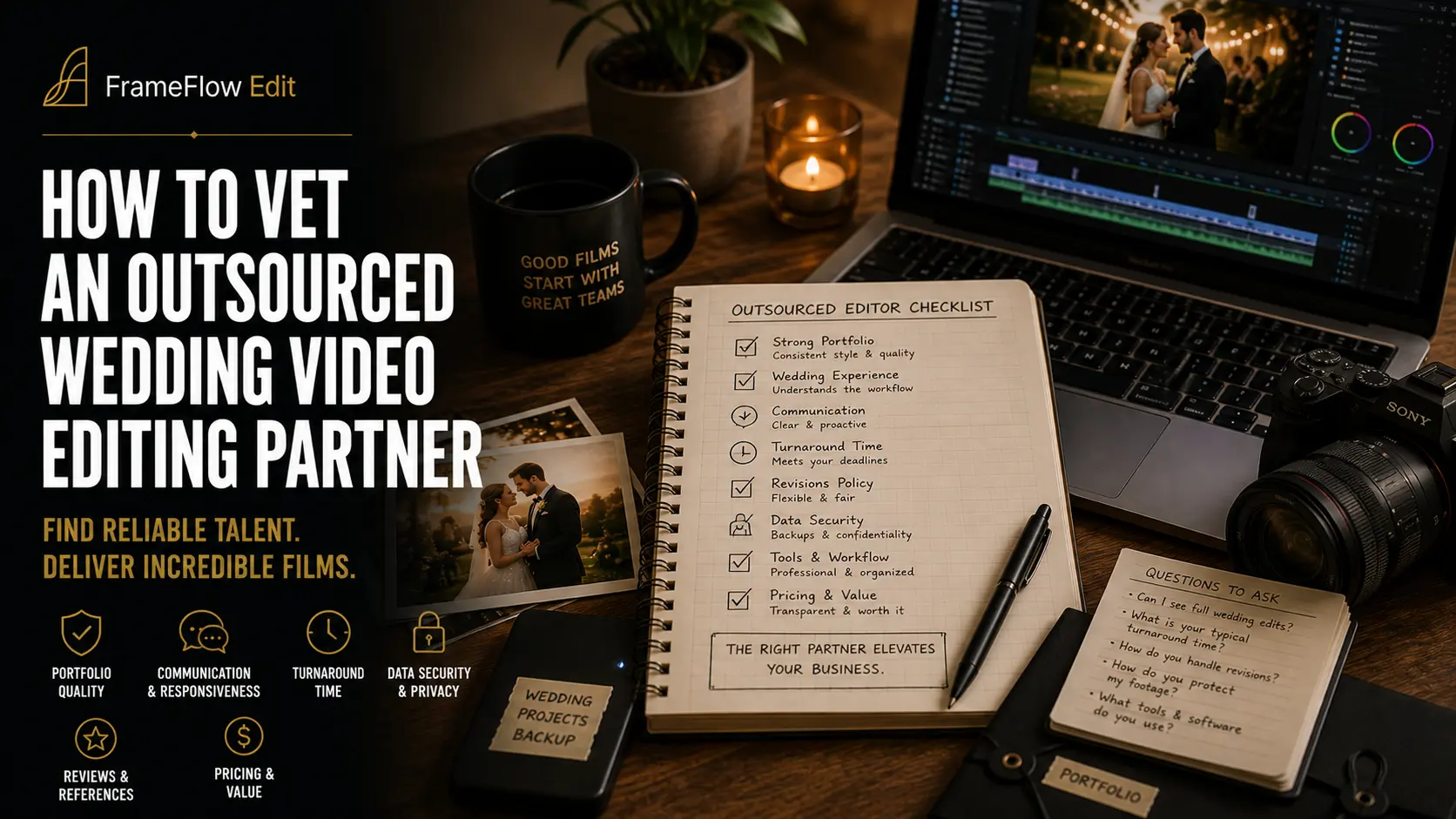
Outsourcing your wedding video editing only pays off if the partner on the other end is reliable, skilled, and honest about what they can deliver. Most videographers who get burned by outsourcing weren't unlucky — they skipped the vetting step and went straight from a nice-looking Instagram reel to a signed agreement. A structured evaluation process, run before any footage changes hands, is what separates a smooth handoff from a season of damage control with couples who are waiting on their films.
The decision to outsource in the first place usually comes after you've hit a ceiling — too many weekends, not enough hours in the week to grade and cut every film to the standard your bookings deserve. Once that decision is made, the temptation is to move fast: find someone with a decent reel, send over a hard drive, and hope for the best. That instinct is understandable and it's also exactly how studios end up with a half-finished film two weeks before a client's anniversary deadline. The checklist below is built to slow that first step down just enough to get it right.
Why Vetting an Editing Partner Is a Business Decision, Not a Shortcut
Handing footage to an outside editor is not a purchasing decision like buying an ND filter — it's closer to hiring a subcontractor who will represent your studio's name on every delivery. The couple never sees the editor's name; they see yours. That means every missed deadline, every off-brand cut, and every awkward color grade becomes a mark against your reputation, not the vendor's.
Treat the search the way you'd treat hiring a second shooter: check the work, check the references, run a paid trial, and get the terms in writing before real weddings are on the line. Studios that skip straight to "send footage, hope for the best" tend to discover the gaps during their busiest month, when there's no time left to switch vendors mid-season.
The goal of vetting isn't to find a flawless editor — it's to find one whose weaknesses you know in advance, so you can plan around them instead of being surprised by them in October.
It also pays to be honest about what "outsourcing" is actually solving for your studio. If the real bottleneck is capacity during peak months, a single well-vetted editing partner who can absorb overflow may be the answer. If it's consistency across every single delivery year-round, you're really looking for something closer to a full production partner. Naming the problem before you start interviewing vendors keeps you from choosing based on price alone and discovering months later that the arrangement never addressed what was actually slowing your studio down.
Match the Portfolio to Your Style, Not Just Its Polish
A polished reel tells you an editor can cut well. It doesn't tell you they can cut like you. A brilliant editor for high-energy, fast-cut highlight films might be the wrong fit for a slow, documentary-style narrative — and vice versa. Watch full films, not just trailers, and specifically look for the moves your brand depends on: pacing during the ceremony, how they handle vows audio, whether the color grade matches the warm, cinematic tone your clients expect.
Ask every candidate for three to five recent full-length wedding films, not sizzle reels. A sizzle reel is edited from the best 90 seconds across 50 weddings; a full film shows you how they sustain pacing and story across 45–60 minutes, which is where most editors' weaknesses actually show up.
It also matters whether the samples are recent. Editing styles — especially color trends and pacing — shift year to year, and a portfolio anchored in work from three years ago tells you little about what you'll receive next month.
Pay attention, too, to how a candidate talks about your footage during the initial conversation, before any contract is on the table. Editors who ask thoughtful questions about your shot list, your typical camera setup, or how you like ceremony audio handled are signaling that they think in terms of your workflow. Editors who respond to every question with a generic pitch about turnaround and pricing are telling you they haven't looked closely at what you actually shoot, which tends to show up later in how well the finished cut matches your style.
Ask for References — and Actually Call Them
Reputable outsourced editing shops expect this request. If a vendor hesitates to connect you with two or three current or recent clients, or offers only written testimonials they control, treat that as a signal worth investigating further rather than a dealbreaker on its own.
When you get a reference on the phone, skip the generic "were you happy with them?" question — you'll get a generic answer. Ask about the specific friction points that matter to your business: how the editor handled a rushed deadline, what happened when the client wanted a fourth round of revisions, and how communication held up during the vendor's own busy season. Those answers tell you more about how the partnership will feel in July than any portfolio can.
It also helps to ask a reference what they'd do differently if they were starting the relationship over. Most people are more candid about lessons learned than they are about a straight yes-or-no recommendation, and a specific answer here — "I'd send more detailed notes on ceremony audio" or "I'd confirm rush pricing upfront" — often points you toward exactly the friction you'd otherwise discover on your own first project.
It's also worth asking references how long they've worked with the editor. A vendor with several references who've stuck around for two or more wedding seasons is a different proposition than one whose references all started within the last few months.
If a candidate can't produce references at all — a common situation with editors who are new to outsourced work — that's not automatically disqualifying, but it does shift more weight onto the next two steps: the test edit and the contract. A newer vendor with strong test results and clean contract terms can still be a good bet, especially if their pricing reflects the fact that they're building a track record rather than trading on one.
Run a Paid Test Edit Before You Commit
A trial project is the single most useful step in this entire process, and skipping it is the most common reason outsourcing relationships fail. No portfolio review or reference call can substitute for watching how a specific editor handles your specific footage under your specific brief.
Structure the test fairly. Send a representative project — your average wedding, not your easiest or your most dramatic — along with the same brief template and turnaround expectation you'd give on a paid engagement. Don't extend extra time "because it's a test"; you want to see how the editor performs under your real conditions, not an artificially generous one. Prepare the footage the same way you would for any real handoff — organized, logged, and accompanied by the same shot notes and reference cues you'd normally send, following the kind of footage hand-off checklist you'd use on a paid project — since a messy test brief will tell you more about your own process than about the editor's.
Pay for the test. Free trial work filters for editors who are desperate for any project, not editors who are confident enough in their pricing to only take paid work. There's no single published industry benchmark for how much a test edit should cost, but paying a meaningful fraction of the standard per-video rate — rather than asking for it free — is enough to attract editors who take the process seriously without asking you to cover a full invoice before you've confirmed the fit.
Decode the Pricing Model Behind Every Quote
Outsourced wedding editing pricing splits into three rough tiers, and each comes with a different trade-off. Marketplace platforms with rotating freelance pools tend to sit at the low end, with inconsistent quality because you rarely get the same editor twice. Dedicated outsource shops that specialize in wedding content sit in the realistic mid-market, with more consistent quality and a named point of contact. Full-service marketing or production agencies sit at the top, often carrying overhead — account management, custom branding — that a working videographer doesn't necessarily need.
Exact pricing is always going to be quote-dependent, so treat any number as a planning benchmark rather than a fixed figure to hold a vendor to before you've seen their actual proposal.
Watch for billing structures as much as headline numbers. Hourly billing on a creative task like editing creates a built-in conflict of interest — the vendor's incentive is to spend more time, not less — and it removes any cost certainty from your own client-facing pricing. Flat per-wedding or per-minute pricing is easier to build your own packages around and easier to explain if a client ever asks how your wedding videography packages are priced.
Also ask directly what a quote includes. Per-revision charges, rush fees, and music licensing pass-through are common places where a "flat rate" quietly turns into a variable one. Reputable shops fold these into the base price and tell you so before you ask.
Think about pricing in terms of your own margin, not just the vendor's invoice. If a wedding package sells for a certain amount and the outsourced edit consumes a large share of that through the base rate plus add-ons, the arrangement may look affordable on the quote but erode the margin you actually need to keep the studio healthy. Run the math against your real packages before you sign, not after the first invoice arrives — it's a much easier conversation to have while you're still comparing vendors than once you're locked into one.
Read the Contract: Ownership, Licensing and NDAs
A contract with an outsourced editor needs to answer three questions clearly: who owns the raw footage, what happens to the final cut, and who is bound to keep the wedding — and your business relationship with the client — confidential.
On ownership, the standard structure in the industry is that you, the videographer, retain ownership of the raw footage and the finished product once payment clears; the editor is typically granted only the rights needed to do the work and, unless you negotiate otherwise, a right to use anonymized clips in their own portfolio. Get this in writing rather than assuming it — "who owns what" is exactly the kind of clause that seems obvious until a dispute makes it not obvious at all.
On confidentiality, an NDA is standard practice when outside vendors handle unreleased client footage, especially footage involving guests, venues, or family details a couple hasn't made public yet. If a vendor resists signing one or wants to charge extra for it, treat that resistance itself as useful information about how they'll handle sensitive material generally.
Long-term lock-in clauses are worth reading closely. In a healthy outsourcing relationship, you keep sending work because the quality and turnaround earn it every time — not because a contract penalizes you for leaving. A vendor who leans heavily on contract length rather than repeat performance to keep clients is telling you something about how confident they are in their own consistency.
None of this requires a lawyer for every engagement, but it's worth having a template reviewed once, before you sign your first agreement with any editing partner, rather than adapting a vendor's own boilerplate contract on the fly. A vendor-supplied contract is written to protect the vendor first; a template you understand and can compare against every future vendor saves you from re-litigating the same ownership and confidentiality questions with each new candidate.
Lock In Turnaround and Revision Terms in Writing
Turnaround time is one of the clearest signals of how a shop actually operates, and it's also one of the easiest things to verify before you sign anything. Ask not just for the standard turnaround, but what happens during peak wedding season, whether rush delivery is available, and what the rush fee actually is.
Be skeptical of round numbers that sound too aggressive relative to the market, and equally skeptical of vague answers about how the timeline changes in busy months — both are common ways an editing shop avoids committing to something they can't reliably hit. A dedicated outsource shop working from a defined process can generally commit to a specific turnaround window and hold it across the season, which is exactly what you need if turnaround itself is part of your own sales pitch to couples, the way it's discussed in turning turnaround time into a sales edge.
Revisions deserve the same clarity. Get the number of included revision rounds in writing, along with what counts as a "revision" versus a new request, and what happens — in cost and time — if a client wants a round beyond what's included. Studios that skip this conversation are the ones who end up eating the cost of an unlimited-revisions client because nobody defined the boundary in advance.
It's also worth clarifying who talks to whom during revisions. Some outsource shops want all client feedback routed through you and translated into edit notes on their end; others are comfortable taking direct notes from your client through a shared portal. Neither model is wrong, but mismatched expectations here are a common source of friction — a client who expects you to be hands-on with every note, paired with a vendor who assumes direct client contact, is a combination that leaves both sides frustrated by round two.
Red Flags That Should End the Conversation
Some warning signs are minor annoyances; others should end the vetting process outright. Learning to tell the difference early saves you from discovering it mid-season, when switching vendors is far more disruptive.
Pricing quotes with "starting from" language and no clear ceiling are one of the most common soft red flags — they're designed to win the initial conversation, not to reflect what a real invoice will look like. Similarly, a shop that quotes an unusually fast turnaround at standard (non-rush) pricing is often either overpromising or quietly relying on rotating freelancers to hit the number, which reintroduces the consistency problem you're trying to solve by outsourcing in the first place.
Watch, too, for vendors who push you toward a decision before you've had a chance to run a test edit or check a reference — urgency ("this rate is only good this week") is a sales tactic borrowed from far less specialized industries, and it has no real place in a relationship where you're about to hand over a couple's only footage of their wedding day.
Hourly billing on editing work, reluctance to provide references, resistance to a paid test edit, and pressure toward a long-term contract before you've seen a single finished cut are all patterns worth taking seriously. None of these alone is necessarily disqualifying, but two or more together is a strong signal to keep looking.
Communication style during the sales conversation is also worth weighing more heavily than most videographers do. A vendor who's slow to respond, vague about who your actual point of contact will be, or unclear about which time zone their team works in is showing you, before you've paid a dollar, what mid-project communication is likely to look like once the relationship is no longer new. Since you're the one who has to answer a couple's "any update on our film?" email, a vendor's responsiveness during vetting is a fair proxy for how much of that burden you'll be carrying yourself later.
Frequently Asked Questions
How much should a test edit cost?
There's no single published industry benchmark for this, so treat any figure as a starting point for negotiation rather than a fixed rule. Paying a meaningful fraction of the vendor's standard per-video rate — rather than asking for the trial free — tends to filter for editors confident enough in their pricing to reserve trial slots for paid opportunities, instead of editors desperate for any work.
What's a reasonable turnaround time for an outsourced wedding edit?
Turnaround varies widely across the outsourcing market, from under a week at some marketplaces offering partial edits to four-plus weeks at agencies with heavier review layers. Some outsourcing shops advertise roughly 10–15 business days for a full cinematic edit, but treat any vendor's quoted number as anecdotal until confirmed in writing — get each vendor's actual number on the record, and ask specifically how it shifts during peak wedding months.
Should I sign an NDA with my outsourced editor?
Yes, in most cases. An NDA is standard practice whenever an outside vendor is handling unreleased client footage, particularly footage involving guests, venues, or personal details a couple hasn't shared publicly yet. A vendor's willingness to sign one without extra charge is itself a useful signal about how seriously they treat confidentiality.
Do I own the raw footage and final cut after I send it to an editor?
Under the standard industry structure, yes — you retain ownership of your raw footage and the finished product once payment is complete, while the editor is granted only the limited rights needed to complete the work (and, if negotiated, permission to display anonymized clips in their own portfolio). Confirm this explicitly in the contract rather than assuming it, since ownership disputes are one of the most common outsourcing conflicts.
How many editors should I test before committing to one?
There's no fixed number, but running a paid test edit with at least two candidates gives you a real basis for comparison rather than judging one vendor in isolation. Comparing two finished test edits side by side, cut from similar footage, tends to surface differences in pacing and color that are much harder to spot when you only ever see one editor's work at a time. If your first test edit clears every criterion — portfolio fit, communication, turnaround, and revision handling — a second comparison test is optional, but it rarely hurts before you commit to a long-term relationship.
What happens if I'm not happy with the finished edit after outsourcing?
This is exactly what a clear revision policy in the contract is for. Confirm, before any footage changes hands, how many revision rounds are included, what counts as a revision versus a new request, and what a round beyond that limit costs in time and money. Studios that define this upfront avoid the awkward mid-project negotiation that happens when a client asks for a fourth round nobody budgeted for. If a finished cut still misses the mark after all included revisions are used, treat that as data for your next vendor review rather than a reason to quietly keep sending work to a partner who isn't the right fit. Many studios also use a partial handoff — outsourcing color grading or sound cleanup alone while keeping the story edit in-house — as a lower-risk way to test a vendor's technical skill before trusting them with a full cut; the same portfolio, reference, and trial-run checks apply at that smaller scale too.