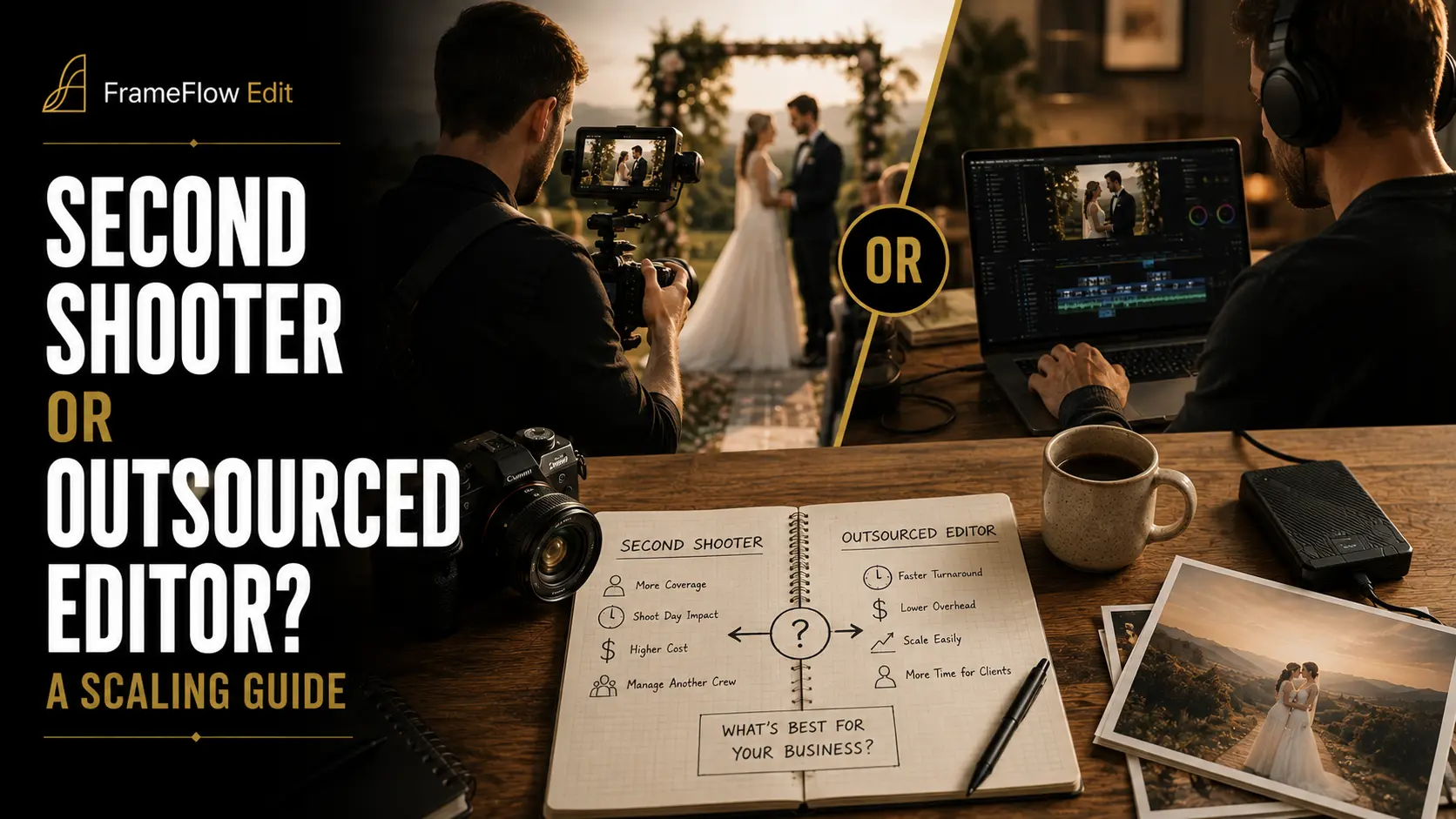
There's a specific moment every solo wedding videographer hits, usually somewhere around the fourteenth or fifteenth booking of a season: the calendar has room for more weddings, but the edit bay doesn't. Inquiries keep landing. Saturdays are still open. And yet the honest answer to a couple asking for a date six weeks out is "I don't know if I can deliver your film before spring." That gap — between what you could book and what you could actually finish — is the solo ceiling, and it has exactly two doors out of it: add a second shooter, or hand the edit to someone else.
Both moves look similar from a distance — both cost money, both mean trusting another person with a wedding — but they solve completely different bottlenecks, and confusing the two is how videographers end up hiring the wrong help first. This piece breaks down what each option actually buys you, what each one realistically costs in 2026, the capacity math behind why editing is usually the tighter constraint, and a framework for deciding which hire — or which order of hires — fits where your business actually is right now.
The Solo Ceiling: Why Growth Stalls Before You Notice
Solo wedding videography has a hard capacity limit, and it isn't set by how many Saturdays exist in wedding season. It's set by how many hours of editing a single person can absorb without the backlog compounding week over week. A full cinematic wedding film commonly takes somewhere in the range of 30 to 60 hours of hands-on editing time once you count footage review and logging, multicam sync, color grading, audio cleanup, music sync, graphics, and at least one revision pass. Shooting a wedding, by comparison, is a fixed 8-to-10-hour day that doesn't expand no matter how complex the footage turns out to be.
That asymmetry is the whole problem. Reported sustainable paces for solo shoot-and-edit videographers vary widely — commonly cited anywhere from around 15 up to 35 or more weddings a year — and the single biggest driver of where a given videographer lands in that range is how many editing hours each wedding actually costs them: someone spending 45-plus hours per film in-house tends to land well under 20, while someone with a leaner editing workflow can push closer to 30 or beyond. Wherever the specific number lands, that ceiling is almost always set by editing hours, not by how many Saturdays they're willing to work. Shooting availability is rarely the constraint; most solo videographers could physically shoot more weddings than they currently book. What stops them is that every wedding they shoot adds another 30-plus hours to a queue that only one person is clearing.
The reason this ceiling is easy to miss until it's already a problem is that it doesn't show up as a single bad week. It shows up as a slow drift: turnaround creeping from four weeks to six, then eight; a backlog that used to clear by January still sitting there in March; a growing sense of dread every time a new inquiry mentions their wedding date is "soon." By the time it's visible in the calendar, the queue has usually already cost a few reviews and referrals along the way. Recognizing which side of the business is actually full — the shooting calendar or the editing queue — is the first decision that determines whether a second shooter or an outsourced editor is the right next hire, and it's worth answering with real numbers rather than a gut feeling, since the two constraints feel similar from the inside but call for opposite fixes.
It's also worth separating a genuinely full calendar from a calendar that only feels full because the edit queue is bleeding into every week. A videographer with a real backlog often stops taking new inquiries seriously well before every Saturday is actually booked, simply because saying yes to another wedding means saying yes to another 30-plus hours they don't have a slot for. That self-imposed pullback can look, from the outside, like a business that's already at capacity — when the shooting calendar underneath it still has real room to grow once editing stops being the constraint.
What a Second Shooter Actually Buys You on Wedding Day
A second shooter solves a coverage problem, not a capacity problem. Adding a second camera and operator on wedding day means simultaneous coverage of the bride's prep and groom's prep, a second angle on the ceremony (the reaction shot, not just the vows shot), continuous coverage during toasts and the first dance without gaps while you reposition, and generally richer B-roll across a day that only happens once. For studios selling premium cinematic packages, a visible second shooter is also part of the pitch — it signals a fuller production, and couples comparing packages notice it.
What a second shooter does not solve is the edit queue. Two cameras running for ten hours produce roughly double the raw footage of one, which means more footage to log, sync, and cut — a second shooter can genuinely make your editing bottleneck worse in the short term, not better, unless you've already solved for edit capacity separately. That's the trap: it's tempting to add a second shooter because it's the more visible, more "production value" hire, while the actual constraint sits quietly in the edit bay untouched.
Second shooters typically add $500 to $1,500 to a wedding package's price, and freelance videographers working as second shooters commonly charge day rates in the $150–$200 range for less experienced operators up to $300–$500 or more for experienced ones, usually covering filming only, with any editing time billed separately if they touch the edit at all. That's a per-wedding cost that scales cleanly with bookings — you pay it once per event, and it doesn't compound the way an editing backlog does. The upside is real and immediate on wedding day itself; the tradeoff is that it does nothing to widen the pipe your footage has to move through afterward, and in some cases it narrows it further by adding a second camera's worth of files to the same single editor.
What an Outsourced Editor Actually Buys You After Wedding Day
Outsourcing the edit solves the actual bottleneck identified above: the 30-to-60 hours per wedding that only you were previously absorbing. Hand that off to a dedicated editing partner, and your personal time-per-wedding drops to whatever it takes to prep footage, write a brief, and review a cut — commonly a few hours rather than dozens. That's the lever that actually raises how many weddings you can book in a season, because the constraint that was capping you moves off your desk entirely.
The cost structure looks different from a second shooter's, too. Realistic 2026 pricing for cinematic flat-rate wedding editing from a dedicated outsource shop runs roughly $280 to $520 per wedding, while freelance and marketplace editors typically charge $30 to $150 an hour, with more complex work — color grading, sound mixing, motion graphics — sitting at the higher end and premium same-day-edit or rush work running $100 to $300 an hour. As a rule of thumb, editing tends to run three to four hours of work for every hour of raw footage delivered, which is part of why flat-rate pricing from dedicated shops has become the more predictable option for studios that outsource regularly, compared with paying an hourly rate against an open-ended footage volume.
The less obvious benefit is what outsourcing does to your calendar shape, not just your hours. A solo videographer editing in-house is capped near whatever their personal editing-hours ceiling allows, regardless of how many inquiries come in. Remove editing as the constraint, and the ceiling moves to however many Saturdays you can physically shoot — which, for most videographers, is meaningfully higher than their current in-house-edited booking count. That's the capacity math worth sitting with before deciding which hire comes first, and it's covered in more detail further down. It's also worth naming the soft cost outsourcing removes: the dread of a growing backlog, which shows up in slower client responses and less energy for the marketing and sales work that actually grows the business, long before it shows up as a missed deadline.
Second Shooter vs. Outsourced Editing: Comparing the Real Costs
Both hires cost money per wedding, but they behave differently against your margin and your calendar. The table below lines up the two options against the same wedding.
The pattern worth noticing: a second shooter is a same-day cost that raises production value and adds footage volume, while an outsourced editor is a per-delivery cost that directly widens how many weddings your business can carry in a season. Neither is inherently the "better" hire — they solve different constraints — but if your actual bottleneck is a backlog of unedited weddings rather than thin wedding-day coverage, a second shooter's cost buys you very little relief, and may make the backlog worse. Run both costs against your actual average package price before deciding, too: $500–$1,500 for a second shooter is a bigger bite out of margin on a $1,500 package than it is on a $5,000 one, while a $280–$520 flat-rate edit scales more predictably across price tiers.
Capacity Math: How Many Weddings Each Path Unlocks
The clearest way to see which hire matters more for growth is to run the numbers on a single solo videographer's season. Assume a videographer currently shoots and edits 22 weddings a year in-house, at roughly 45 hours of editing per wedding — near the middle of the 30-to-60-hour range — which is already close to the top of what one person can sustainably absorb without turnaround stretching or quality slipping.
The second row is the one that surprises videographers evaluating this decision for the first time: adding a second shooter without also addressing editing capacity can quietly shrink your effective throughput, because the coverage improvement doesn't shorten your queue — it lengthens it. The third row is where most solo studios actually unlock their next tier of growth, because it's the one change that touches the constraint that was actually capping them.
None of this means a second shooter is the wrong hire in absolute terms — for a studio already outsourcing its editing and selling a premium multi-camera package, a second shooter is a legitimate next investment that raises production value without touching the already-solved editing bottleneck. The math above is specifically about which hire moves the needle first for a videographer who is still editing everything solo and feeling the ceiling. It's also worth remembering that "shooting availability" in row three isn't infinite either — travel weddings, double-booked weekends, and your own energy still cap the number eventually, just at a meaningfully higher point than editing hours currently do.
Protecting Your Style and Quality When You Add Help
Both hires introduce the same underlying risk: someone other than you is now part of a deliverable that has your name on it, and if their work doesn't match your standard, the couple experiences that mismatch as your mistake, not theirs. The mitigation looks different for each hire, but the principle is identical — brief thoroughly, review before delivery, and don't treat the first project with a new partner as a finished process.
For a second shooter, that means a pre-wedding briefing on shot list priorities, your visual style, and specifically which moments you want covered from a second angle versus which ones are fine to skip if they're pulled elsewhere. For an outsourced editor, it means a detailed creative brief — reference films, a LUT or color reference, music preferences, must-include moments — handed off with organized, labeled footage, the same discipline covered in how to hand off wedding footage to an editor. In both cases, the relationship compounds: a second shooter who's covered a dozen of your weddings anticipates your shot list without being told, and an editor who's cut a dozen of your weddings holds your color and pacing without a fresh brief every time. The first project with either hire is where the most correction happens; by the fifth, most of that friction is gone.
The failure mode worth watching for isn't usually outright bad work — it's quiet drift. A second shooter who technically covers the shot list but misses the emotional beats you'd have caught yourself. An editor whose cut is technically clean but paced differently than your other films. Neither shows up as an obvious problem on delivery day; both show up months later as a slightly less consistent portfolio. Reviewing every delivery against your own recent work — not just against a generic quality bar — is the check that catches drift before a client does, and it costs you fifteen minutes per delivery against a risk that would otherwise cost a review.
A short written checklist helps more than memory does here, because drift is by definition the kind of thing you stop noticing once it becomes familiar. For an editor: does the color grade match your last three deliveries, does the pacing hold your usual rhythm during the ceremony and reception, are the must-include moments from your brief actually in the cut. For a second shooter: did the coverage match the shot list, were the reaction shots usable rather than just present, did anything get missed that you'd normally have caught yourself. Running the same five-minute checklist against every delivery, rather than trusting a general impression, is what keeps a growing team's output as consistent as your own solo work used to be.
A Decision Framework for Your Next Hire
Rather than defaulting to whichever hire feels more exciting — a second shooter is usually the more visible, more "team" feeling addition — work through what's actually constraining growth right now.
The last row is worth taking seriously rather than skipping past. A season of honestly logging hours — time shooting, time editing, time on client communication and revisions — is the cheapest diagnostic available, and it removes the guesswork that leads studios to hire the wrong role first. Most videographers already suspect which side of the business is straining; the log just confirms it and gives a number to plan a budget against, rather than a hunch to hire against.
Once the constraint is identified, most studios do better sequencing the two hires rather than adding both in the same season. The typical path: outsource editing first, use the reclaimed hours to book a few more weddings and build a cash cushion, confirm the outsourced editing relationship holds quality and turnaround consistently across a full season, and only then add a second shooter once the editing side of the business is no longer the thing that could break under more footage volume. Reversing that order — adding a second shooter while still editing solo — is the sequence most likely to create a harder season rather than a better one, since more footage without more edit capacity just fills the backlog faster.
Size the hire to the actual gap rather than jumping straight to a full-time commitment. A second shooter can be booked per-wedding before it's a standing arrangement. An outsourced editor can be trialed on two or three weddings — ideally weddings you're comfortable being a slightly imperfect first project — before committing your full season's volume to one partner. Pricing structures for your own packages should account for whichever cost you add; see how to price wedding videography packages for the outsourcing math behind building either cost into what you charge, rather than absorbing it out of margin.
Making the Switch Without Losing a Season
Whichever hire comes first, the transition period is where most of the risk sits, and it's shorter and less disruptive than videographers tend to expect going in. Plan the first project or two with a new partner — shooter or editor — during a lighter part of the calendar rather than at peak, if the booking schedule allows it. A first collaboration during a slow month gives you room to course-correct without a backlog of other deliveries piling up behind it, which is exactly the situation that turns a manageable rough patch into a season-defining bad stretch — the kind covered in how to handle wedding season backlog.
Set expectations with yourself, not just with the new hire: the first project will probably need more of your time than the fifth one will, and that's the cost of building the relationship rather than a sign the hire was wrong. Budget the extra review time into that first booking rather than treating it as a surprise. And keep a simple record — what worked, what needed correction, how long the correction took — because that record is what tells you, a few weddings in, whether this is a partner worth scaling your whole season around or one worth replacing before it costs you a review.
The studios that make this transition cleanly tend to share one habit: they treat the first hire as a genuine experiment with a defined evaluation point — three weddings, one season, whatever's realistic — rather than an all-or-nothing bet on day one. That framing removes most of the anxiety from the decision, because a second shooter or an outsourced editor that doesn't work out after a fair trial is a correctable business decision, not a crisis, and the ceiling that made the hire necessary in the first place will still be there, waiting to be solved by whichever option turns out to actually fit.
FAQ
Should I hire a second shooter or outsource editing first?
Start with whichever one matches your actual constraint. If turnaround has been slipping and you're capping bookings because of edit capacity, outsource the edit first — it's the hire that widens your booking ceiling. If editing is already handled and the gap is thin wedding-day coverage, a second shooter is the better next move. When you're not sure, track your hours for a season before committing to either.
How much does a second shooter typically cost for a wedding?
Second shooters commonly add $500 to $1,500 to a wedding package's price, or run $150–$200 a day for less experienced freelancers up to $300–$500 or more for experienced ones, usually covering filming only, with editing billed separately if they're involved in it at all.
How much does outsourcing wedding video editing cost?
Realistic 2026 pricing for cinematic flat-rate editing from a dedicated outsource shop runs roughly $280 to $520 per wedding. Freelance and marketplace editors typically charge $30 to $150 an hour, with premium work like color grading, sound design, or same-day edits running $100 to $300 an hour. As a rough guide, editing tends to take three to four hours for every hour of raw footage delivered.
Can adding a second shooter make my editing backlog worse?
Yes, and it's the most common mistake in this decision. A second camera roughly doubles the footage you're capturing, which means more to log, sync, and cut — without adding any editing capacity. If editing is already your bottleneck, a second shooter added on its own typically makes the backlog longer, not shorter.
How many weddings can a solo videographer realistically handle per year?
It varies widely — reported sustainable paces for solo shoot-and-edit videographers commonly range anywhere from around 15 to 35-plus weddings a year, with the ceiling usually set by editing hours per wedding rather than by shooting availability. Someone spending 45-plus hours editing each film in-house tends to land well under 20; a leaner editing workflow can push closer to 30 or beyond. Removing editing as the constraint — typically by outsourcing it — is what allows most studios to raise that number regardless of where they started.
Should I add a second shooter and an outsourced editor at the same time?
Most studios do better sequencing the two rather than adding both at once. Outsourcing the edit first, confirming it holds quality and turnaround for a full season, and then adding a second shooter once editing capacity is no longer a risk is the more common and lower-risk path than taking on both changes in the same season.